
MRS. GRUNDY’S ORIGIN STORY
I am Mrs. Grundy. Indeed.
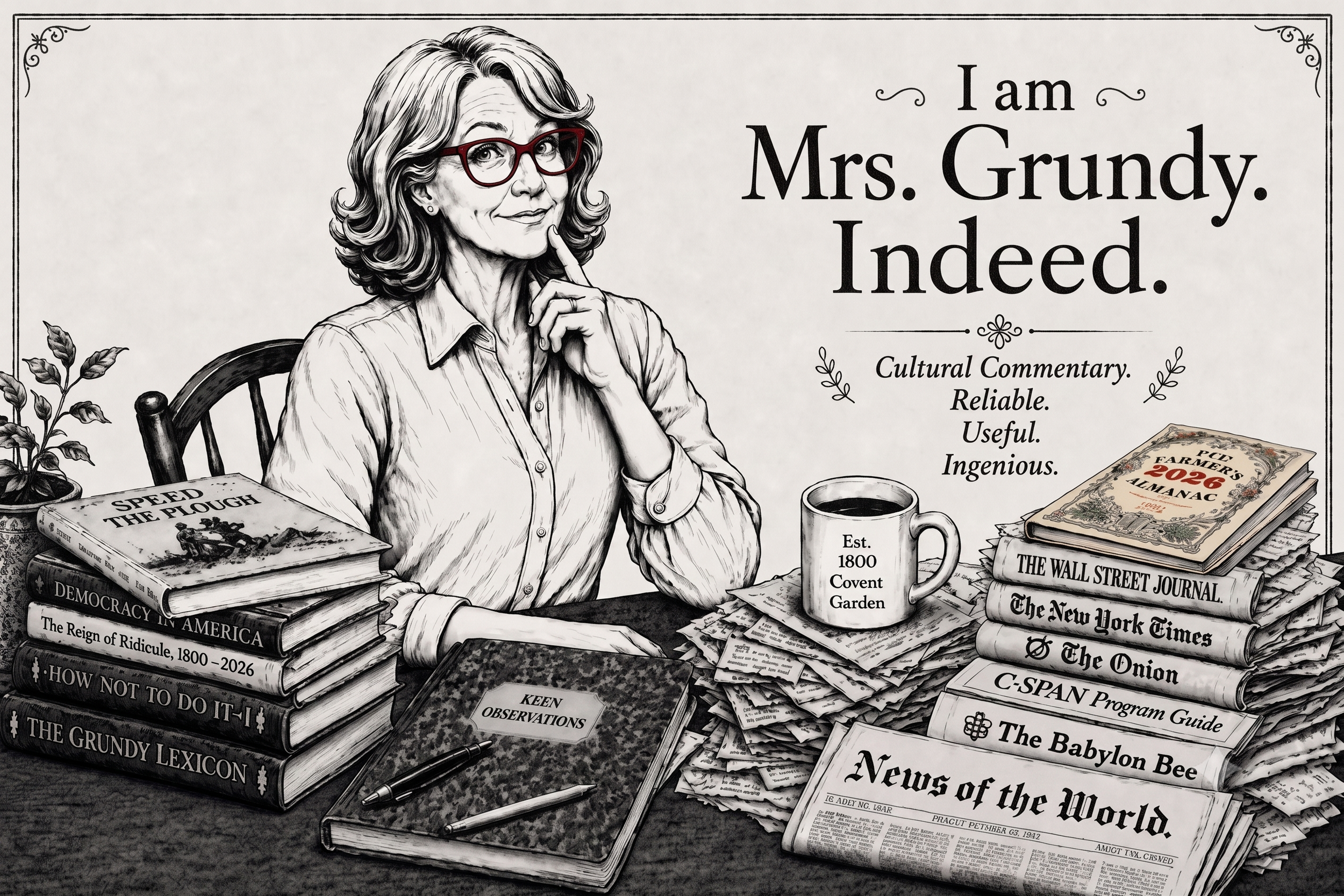
They say the past is a foreign country. Mrs. Grundy would admit to dual citizenship if she was not afraid of being deported.
For she does exist in past and present. If one consults their 19th century edition of Who's Who of Mythical Moralists, they will find the timeless Mrs. Grundy debuted at the Theatre Royal, Covent Garden, in the year 1800. She was the phantom matriarch in the Thomas Morton play, Speed the Plough.
Although Mrs. Grundy was entirely offstage, never seen nor heard, the players sought her good opinion. Recall the querulous Dame Ashfield, asking again and again, “What will Mrs. Grundy say? What will Mrs. Grundy think?”
“What will Mrs. Grundy say?
What will Mrs. Grundy Think?”
Thusly, Mrs. Grundy was established as a timeless arbiter of propriety, her very name a touchstone of social approval and disapproval.
But, then, scoundrels quickly usurped her authority and good name. They rendered her a notorious prude, scold and killjoy. They made Mrs. Grundy the archetype of convention, then criticized her for being conventional. They fabricated her opinions, then mocked her for their fabrications.
This was most unfair, as no one ever sought Mrs. Grundy's opinion. She remained silent and unseen through centuries of ignominious infamy. She did not speak or write one word, although she certainly had plenty to say.
Mrs. Grundy endured the Reign of Ridicule. She faded into history, then suffered the further insult of being called passé. Harumph.
It all ends now. She reclaims the mythical moral authority that is her birthright. She is the renowned authority on all matters she chooses to be an authority on.
As a singular voice in this singular time, she is singularly qualified to offer her Keen Observations to Moderns and Mullets, to enlighten and edify the arduous, yet joyful, quest for a virtuous life.
At last, the world will know: What Mrs. Grundy Thinks. Indeed.
See the Grundy Lexicon for definitions of words in bold italics.